

The Cost of Being Sick
 Eda Koselleck
How Medical Debt Creates Barriers to Healthcare in America

Imagine receiving a medical bill after an unexpected illness or accident. The treatment may have been necessary, the doctor may have done everything right and you may even have health insurance. Yet, the bill can still be financially devastating. For millions of Americans, the consequences of becoming ill do not end when they leave the hospital. They can continue through unpaid bills, debt collection, damaged credit and reduced household spending. Ultimately, they start questioning whether they can afford to seek medical care again.
Medical debt is therefore more than a financial problem. It is increasingly a healthcare-access problem. When the price of treatment becomes a barrier to receiving treatment, the financial structure of the healthcare system begins to influence who receives care, when they receive it and what health outcomes they experience.
The United States illustrates this problem particularly clearly. Despite having one of the world’s most advanced healthcare systems, Americans continue to face significant financial barriers to accessing medical care. A 2026 Presidential Advisory from the American Heart Association described healthcare affordability as a growing crisis, noting that U.S. national health expenditures reached $5.3 trillion in 2024, while patients continue to experience delayed or forgotten care, financial hardship and medical debt.
The central question is therefore not simply how much healthcare costs. It is what happens when people cannot afford to pay for being sick.
When Healthcare Becomes Something People Cannot Afford to Use
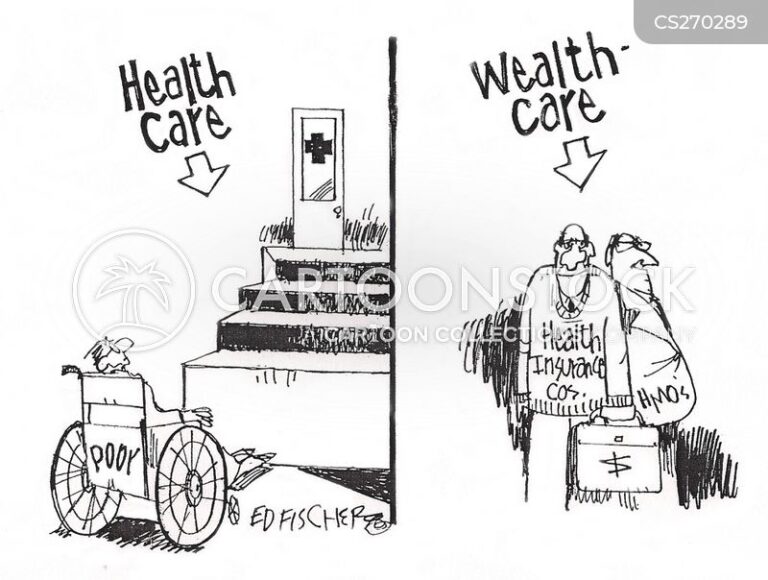
The most concerning consequence of medical debt is not necessarily the debt itself. It is what people do to avoid creating more of it. Healthcare costs can influence decisions long before a patient receives a bill. Individuals who fear the financial consequences of treatment may postpone routine appointments, avoid preventive care, delay diagnostic testing, ration medication or simply decide not to seek medical attention until their condition becomes impossible to ignore.
Research summarized by Washington University’s Center for Social Development highlights this connection between economic stability and healthcare access. High healthcare costs can cause people to skip routine care, avoid emergency care or struggle to fill prescriptions. Financial difficulties can also interfere with adherence to treatment, meaning that obtaining a prescription is not necessarily the same as being able to follow the prescribed treatment.
The American Heart Association’s 2026 Presidential Advisory reaches a similar conclusion. Rising healthcare costs, coverage gaps and cost-sharing are contributing to delayed or forgone care, medical debt and worse health outcomes. This creates a dangerous paradox. The more expensive healthcare becomes, the more likely some patients are to avoid healthcare and the more likely untreated conditions are to become expensive emergencies.
A patient who postpones a consultation because of cost may eventually require emergency treatment. Someone who cannot consistently afford medication may experience a deterioration of a chronic condition. A person who postpones diagnostic testing may discover a serious illness only after it has progressed.
The result can be a cycle:
high healthcare costs → delayed care → worsening health → more intensive treatment → higher costs → medical debt.
Medical debt can therefore both result from poor health and contribute to poorer health.
The People Most Exposed Are Often Those Least Able to Absorb the Cost
Medical debt does not affect all Americans equally. Peterson-KFF data show that adults in worse health and people living with disabilities are more likely to report medical debt. Individuals with complex health needs may accumulate bills over time, while illness or disability can simultaneously reduce their ability to work and earn income.
Income also matters. Lower- and middle-income Americans are substantially more vulnerable because they have fewer financial resources with which to absorb unexpected medical expenses. In 2021, approximately one in ten adults with household incomes below 400% of the federal poverty level reported medical debt.
The burden is also uneven geographically and across racial groups. Peterson-KFF found that Black adults were more likely to report medical debt than White and Asian adults, while people living in rural areas and in the South also faced higher levels of medical debt.
Nuñez similarly identifies medical debt as a problem disproportionately affecting low-income, Southern, Black and Hispanic Americans. He connects these disparities partly to differences in insurance coverage and the unequal distribution of wealth and financial resources.
This means that medical debt can reinforce existing health and economic inequalities. A wealthy household may be able to absorb a large unexpected bill through savings. A low-income household may have to choose between paying the hospital, paying rent, buying food or purchasing medication.
Healthcare costs can therefore become a mechanism through which illness produces poverty and poverty makes healthcare harder to obtain.
Health Insurance: Protection or Incomplete Shield?
The American healthcare system relies heavily on health insurance to protect individuals from the full cost of medical treatment. Yet the existence of insurance does not necessarily guarantee financial security.
The Affordable Care Act (ACA) significantly expanded access to health insurance, including through Medicaid expansion and health insurance marketplaces. It also prohibited insurers from denying coverage because of pre-existing conditions and allowed young adults to remain on their parents’ insurance plans until age 26. However, the structure of the ACA also illustrates how complicated healthcare access can become when insurance coverage varies according to income, employment and state policy.
Following the Supreme Court’s 2012 decision in National Federation of Independent Business v. Sebelius, Medicaid expansion became effectively voluntary for states. As a result, some states did not expand Medicaid, creating a so-called “coverage gap” for certain low-income adults who earn too much to qualify for traditional Medicaid but too little to receive marketplace subsidies. The Roosevelt Institute estimates that approximately 1.4 million people fall into this coverage gap, with the overwhelming majority living in the South.
Even outside this gap, people can remain underinsured. A plan may technically cover a procedure while leaving the patient responsible for a deductible or significant cost-sharing. This means that the question “Do you have insurance?” is increasingly insufficient. A more meaningful question is:
“Can you actually afford to use the insurance you have?”
Where Does the Law Come In?
The medical debt crisis raises a fundamental legal question: how much financial risk should an individual be expected to bear in order to access medically necessary healthcare?
The answer is complicated because the United States does not treat healthcare as a universal legal entitlement in the same way that some other countries structure access to healthcare. Instead, access is mediated through a combination of private insurance, employment, government programs, individual payments and consumer-protection rules.
This makes legal regulation particularly important.
One area concerns healthcare pricing and transparency. Patients can face significant difficulty determining the eventual cost of treatment before receiving it, particularly where insurance coverage, provider networks, deductibles and negotiated prices interact. Greater transparency can help patients understand their potential financial obligations, although transparency alone cannot solve the underlying problem of high prices or inadequate insurance.
A second area concerns debt collection and consumer protection. Once medical bills become delinquent, patients may encounter collection activity in addition to the original financial burden. Consumer-protection law therefore becomes relevant to determining what creditors and collection agencies may do when pursuing medical debts.
A third issue is medical debt and credit reporting.
The Consumer Financial Protection Bureau (CFPB) took steps during the Biden administration to limit the impact of medical debt on credit reports. In 2023, the three major credit reporting companies agreed to remove paid medical debts, debts less than one year old and certain smaller medical debts from consumer credit reports. In January 2025, the CFPB went further by issuing a rule intended to prohibit medical debt from appearing on credit reports and prevent lenders from using such debt in lending decisions. The Roosevelt Institute notes, however, that the future and effectiveness of such regulatory measures depend on subsequent legal and political developments.
These measures illustrate an important principle: a person becoming sick should not automatically become a worse financial risk in every other area of life.
At the same time, removing medical debt from credit reports does not eliminate the debt itself. It cannot restore money that a family has already spent, compensate for lost wages, or guarantee that a patient will be able to afford future treatment.
Credit reporting reform can therefore mitigate one consequence of medical debt, but it cannot address its root cause.
When the Cost of Treatment Determines Whether Treatment Happens
The medical debt crisis ultimately forces us to reconsider what “access to healthcare” really means. Formal access is not the same as practical access. A patient may technically be able to visit a doctor, but if the consultation costs too much, access is effectively restricted. A medication may be legally available, but if the patient cannot afford the prescription, it is not meaningfully accessible. An insurance plan may exist, but if its deductible is financially impossible to meet, coverage may offer little protection when treatment is actually needed.
This is why medical debt should not be understood solely as a consequence of individual financial hardship. It is also a measure of how the healthcare system distributes financial risk. The Peterson-KFF data demonstrate the scale of that risk: at least $220 billion in medical debt was owed by Americans in 2021, with the greatest burden falling on people who were already more vulnerable because of low income, poor health, disability or lack of insurance.
Meanwhile, emerging medical evidence and policy analysis increasingly show that affordability affects whether people seek care, whether they adhere to treatment and whether health conditions are addressed before they become more serious.
The consequence is a vicious cycle in which illness can create debt, debt can restrict access to healthcare, and restricted access can worsen illness.
Breaking that cycle requires more than helping people manage their bills after treatment. It requires confronting the legal, economic and healthcare structures that allow the price of necessary medical care to become a barrier to receiving it. For a healthcare system to provide genuine access, being able to receive treatment cannot depend entirely on whether a person can afford the financial consequences of becoming sick.
Healthcare may be expensive. But the cost of being sick should not be the loss of access to healthcare itself.
Sources:
– Abdullahi Tunde Aborode, Oreoluwa Oginni, Modesta Abacheng, Ottoho Edima et al., “Healthcare debts in the United States: a silent fight”, 21 January 2025, Annals of Medicine & Surgery [Available at: https://pmc.ncbi.nlm.nih.gov/articles/PMC11918610/]
– Stephen Nuñez, “The US Medical Debt Crisis: Catastrophic Costs of Insufficient Health Coverage”, 15 May 2025, Roosevelt Institute [Available at: https://rooseveltinstitute.org/publications/medical-debt/]
– Shameek Rakshit, Matthew Rae, Gary Claxton, Krutika Amin, Cynthia Cox, “The burden of medical debt in the United States”, 12 February 2024, Peterson-KFF Health System Tracker [Available at: https://www.healthsystemtracker.org/brief/the-burden-of-medical-debt-in-the-united-states/#Share%20of%20adults%20who%20have%20medical%20debt,%20by%20health%20status%20and%20disability%20status,%202021]
– John August, “Healthcare Insights: How Medical Debt Is Crushing 100 Million Americans”, 21 October 2024, Cornell University [Available at: https://www.ilr.cornell.edu/scheinman-institute/blog/healthcare-insights/healthcare-insights-how-medical-debt-crushing-100-million-americans]
– Dhruv S. Kazi, Joshua A. Beckman, Regina M. Benjamin, Grace Firestone et al., “Health Care Affordability in the United States, From Crisis to Action: A Presidential Advisory Form the American Heart Association”, 30 April 2026, AHAIASA Journals [Available at: https://www.ahajournals.org/doi/10.1161/CIR.0000000000001442]
– Joshua P. Cohen, “Increasing Burdens Of Medical Debt And Bankruptcy Are Uniquely American”, 05 April 2026, Forbes [Available at: https://www.forbes.com/sites/joshuacohen/2026/04/05/increasing-burdens-of-medical-debt-and-bankruptcy-are-uniquely-american/]
– Alejandra Muñoz-Rivera, “How do health care costs impact household finances and access to care”, 20 September 2022, Brown School Center for Social Development [Available at: https://csd.wustl.edu/how-healthcare-costs-impact-household-finances-and-access-to-care/]

Eda Koselleck
- Eda Koselleck
- Eda Koselleck
- Eda Koselleck
- Eda Koselleck


