

Is Healthcare a Right or a Privilege?
 Eda Koselleck
A Legal Perspective on the U.S. Healthcare System
Introduction
There are only a few debates in American public policy which are so polarizing and difficult. When it comes to healthcare we are immediately faced with this unpleasant dilemma, should it be considered a fundamental right or is it a market-based privilege?
Unlike many industrialized nations, the U.S. has historically resisted framing healthcare as a fundamental right, but chose to deal with it via a set of complex interplay of constitutional interpretation, federalism and incremental legislation. Bearing this historical reality in mind, this blog examines whether American law recognizes a right to a healthcare system, and if yes to what extent.
Constitutional Background
Does the U.S. Constitution Guarantee Healthcare?
Even though healthcare is considered a human right in international law, the U.S. Constitution does not explicitly recognize a ‘right to healthcare’, as it does in free speech or due process. Courts have consistently held that ‘healthcare is not a fundamental right protected under the Constitution’. This is partly because the ‘right to healthcare’ in the U.S. is a ‘negative right’ meaning the Constitution aims to limit government interference to the health system, rather than seeing it as a ‘positive obligation’ requiring government services.
However, there have been some exceptions in this understanding, such as in Estelle v. Gambele, 429 U.S. 97 (1976). In their resolution the Supreme Court has ruled that ‘deliberate indifference’ by prison officials to a prisoner’s serious medical needs constitutes ‘cruel and unusual punishment’ violating the 8th Amendment, which prohibits such behaviour. As a result, any broad recognition of healthcare as a right under the Constitution would require a profound legislative action, rather than a judicial interpretation.
The Role of Federalism (State vs. Federal Responsibility)
Federalism plays a key role in shaping the healthcare policy in the U.S. since the authority is divided between federal and state governments. This automatically creates a fragmented system
of regulation and delivery and the States prefer holding their primary responsibility for public health and safety under their strict provision. This includes licensing healthcare providers, regulating insurance markets and administering public health programs, which might vary from State to State. At the same time, the federal government tries to establish a common healthcare system through funding, regulation and nationwide programs.
This fragmentation in the system might be seen as positive and flexible since States can innovate and tailor policies to their local needs, but it is also inconsistent since they produce unequal access to healthcare across the country. For example, differences in Medicaid expansion under the Affordable Care Act (ACA), often called ‘Obamacare 2010’, have led to significant disparities in coverage based on geographic location.
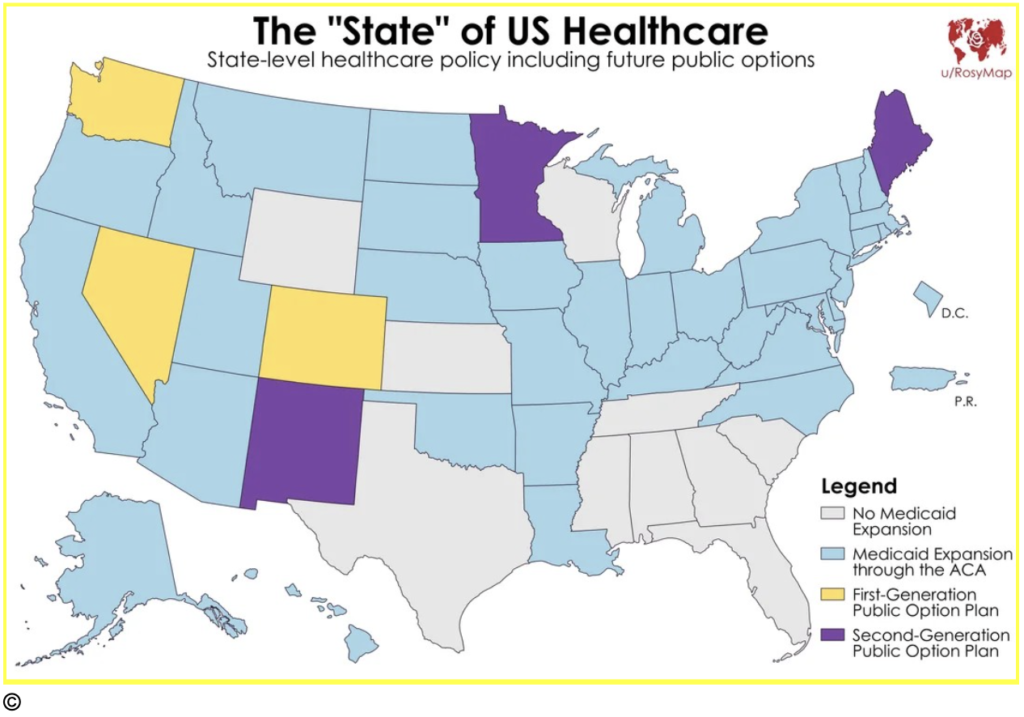
https://www.reddit.com/r/MapPorn/comments/1hhyuaj/statelevel_healthcare_policy_in_the_us/
Basis for Healthcare Legislation: Commerce Clause & Spending Power
Although healthcare is not guaranteed under the Constitution, it provides Congress with tools to legislate in this area, primarily through the Commerce Clause and the Spending Clause (Article I, Section 8, Clause 1 of the Constitution) empowering the Congress to promote general welfare.
The Commerce Clause, for example, allows Congress to regulate activities that substantially affect interstate commerce under which healthcare and insurance markets fall. Therefore, this clause has been long used to justify federal healthcare regulations. Another tool is the Spending Clause which enables the Congress to allocate funds to states and attach conditions to that funding. This power supports major healthcare programs such as Medicaid, where states receive federal funding in exchange for complying with federal requirements. Together, these provisions form the constitutional backbone of modern healthcare legislation, allowing the federal government to shape an overall healthcare policy without establishing a direct constitutional right.
Key Legal Milestones
Medicare & Medicaid (1965)
Medicare, a federal program targeting primarily people aged 65+ and some younger than 65 with disabilities, and Medicaid, a joint federal-state program for low-income individuals of any age, children and pregnant women, marked a turning point in U.S. healthcare policy. These programs established government-funded healthcare for specific populations, sometimes qualifying for both programs. In such cases typically Medicare pays first and Medicaid covers the remaining cost since the funding is a mixture of state and federal, meaning varying from state to state. While both programs are extremely important and expanded access significantly, they did not create a universal right to healthcare since eligibility and benefits vary and remain conditional.
The Affordable Care Act (2010)
The Affordable Care Act (ACA), often called ‘Obamacare’ as mentioned before, represented the most comprehensive healthcare reform in decades in the U.S. It aimed to expand coverage through insurance marketplaces offering insurance plans, subsidies for moderate income families and Medicaid expansions in States. It is designed to address a broader group than what medicaid covers. Moreover, it also introduced important consumer protections such as prohibiting denial of coverage for preexisting conditions. Still, despite its broad reach and improved conditions, the ACA did not declare healthcare a universal right. Instead, it could only reinforce a hybrid system combining public programs with private insurance.
NFIB v. Sebelius (2012)
A defining legal moment came with the Supreme Court’s decision in NFIB v. Sebelius. The Court upheld the ACA’s individual mandate as a valid exercise of Congress’s taxing power, not the Commerce Clause. This means the Court determined the ‘penalty’ for not having insurance was actually a tax, therefore constitutional under Congress’s taxing power and rejected the argument that Congress could compel individuals to buy health insurance under the Commerce Clause. This decision made the constitutional boundaries of federal authority visible and reinforced the importance of State participation in national healthcare initiatives.
Structural Consequences
As evidenced, the absence of a constitutional right to healthcare has led to a fragmented and unequal system, often depending on employment, income, age or geographic location. Even though federal programs try to provide certain safeties it remains limited. This structure reflects that in the U.S. healthcare is treated as a policy choice, therefore it can only expand or contract depending on political priorities and legislative changes.
Reform Pathways
Future reforms could move the U.S. closer to recognizing healthcare as a right, but each pathway has its own legal and political challenges.
– Incremental Expansion: building on existing programs like Medicaid and the ACA to increase coverage
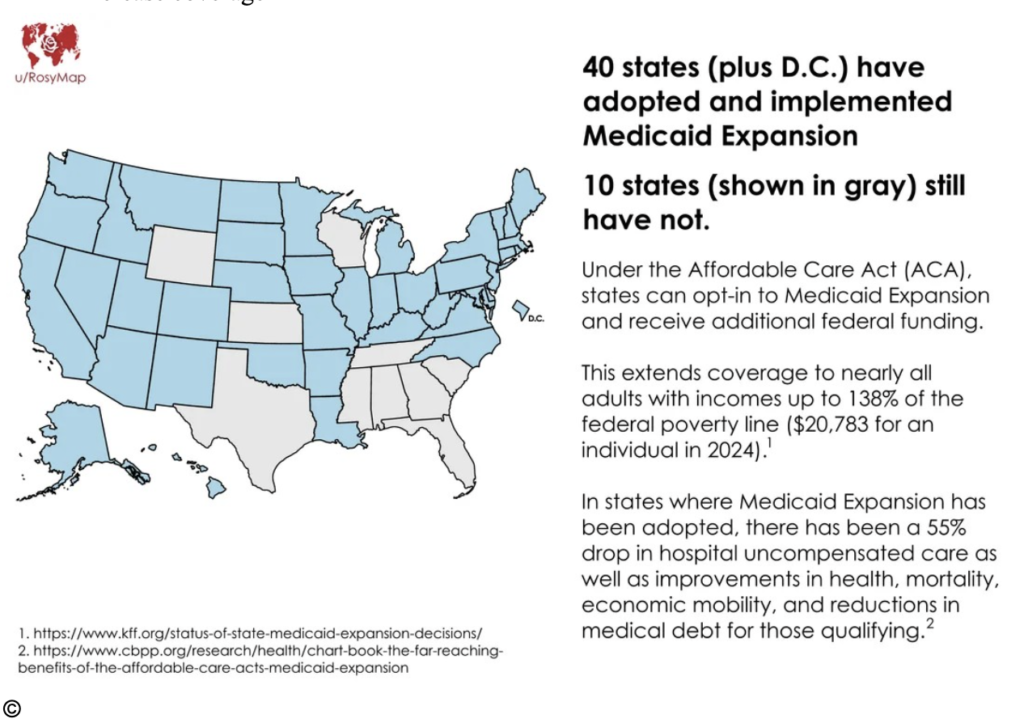
https://www.reddit.com/r/MapPorn/comments/1hhyuaj/statelevel_healthcare_policy_in_the_us/
– Public Option Models: introducing government-run insurance alongside private plans
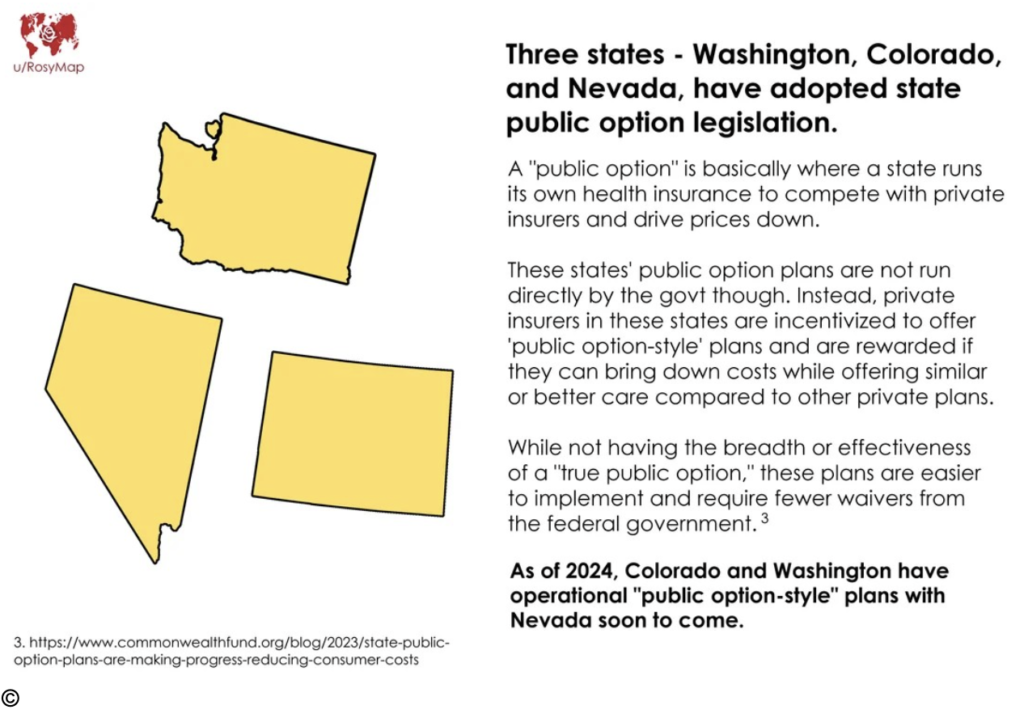

– Universal Coverage Systems: proposals such as single-payer healthcare, a model where a single public agency and usually the government finances healthcare for all residents, replacing private insurance companies, which would require significant legislative change
– State-Level Innovation: States experimenting with broader coverage models under federal waivers
Any reform would therefore not only require a legislative, but a broader rethinking of constitutional interpretation and public policy priorities.
Conclusion
The question of whether healthcare is a fundamental right or a privilege in the U.S. does not have a simple answer. Legally, it remains a privilege since it is not guaranteed by the Constitution. Yet the persistence of this debate and the above mentioned efforts to structure it through statues reflects a deeper tension between competing visions of justice, equality and the role of government needing to observe it as a fundamental right. To conclude, it remains to be seen how the healthcare challenges evolve and will be defined both legally and socially.
Sources
– https://www.healthequityandpolicylab.com/elusive-right-to-health-care-under-us-law
– https://pmc.ncbi.nlm.nih.gov/articles/PMC9610686/
– https://www.uclahealth.org/news/release/a-constitutional-right-to-health-care
– https://hsph.harvard.edu/news/healthcare-is-a-human-right-but-not-in-the-united-states/
– https://hsph.harvard.edu/news/how-and-when-federalism-is-good-for-public-health/
– https://www.forumfed.org/document/federalism-and-health-care-policy/
– https://pmc.ncbi.nlm.nih.gov/articles/PMC3151195/
– https://scholarship.law.ufl.edu/cgi/viewcontent.cgi?article=1152&context=flr
– https://scholarlycommons.law.wlu.edu/cgi/viewcontent.cgi?article=2301&context=wlulr
– https://www.congress.gov/crs_external_products/LSB/HTML/LSB10787.html
– https://www.health.harvard.edu/staying-healthy/medicare-versus-medicaid-key-differences
– https://www.archives.gov/milestone-documents/medicare-and-medicaid-act
– https://www.ncbi.nlm.nih.gov/books/NBK549767/
– https://www.healthcare.gov/glossary/affordable-care-act/
– https://supreme.justia.com/cases/federal/us/567/519/
– https://de.wikipedia.org/wiki/National_Federation_of_Independent_Business_v._Sebelius

Eda Koselleck
- Eda Koselleck
- Eda Koselleck
- Eda Koselleck
- Eda Koselleck


